With a high meat yield, few bones, and high nutritional value, tambaqui (Colossoma macropomum) remains one of the most sophisticated and sought-after fish species in both fisheries and cuisine. Native to the freshwater basins of the Amazon, the species is considered a symbol of Brazil’s aquatic fauna and plays a central role in fish production in the Northern region, as well as in recipes of many people.
This success goes beyond flavour. According to Professor Igor Hamoy, from the Federal Rural University of the Amazon (UFRA), the species has characteristics that encourage fish producers both in the Amazon and in other countries around the world.
“Tambaqui is the second largest scaled fish in the Amazon basin, reaching over one meter in length and weighing more than 30 kg in its natural environment. Large-scale captive production of this specie is driven by its rapid adaptation to artificial feeding, rusticity and resistance to farming systems, strong response to artificial induced reproduction, efficient feed conversion, and excellent weight gain”, attests the researcher from the UFRA Applied Genetics Laboratory.
CHINESE
Despite being native to the Amazon, the title of largest tambaqui producer lies more than 16.000 km away, specifically on the Asian continent. According to a publication on the website CGP Click Petróleo e Gás, the most recent research indicates that China led global tambaqui production in 2024, both in terms of volume and exports.
According to a UFRA professor, some factors explain this shift in global ranking, placing the Asian giant at the top of the production chain.
“China has advanced technology in fish-farming (the farming of fish in captivity for commercial purposes or as a hobby). They also use DNA as a tool. In addition, China holds a very large consumer market, cheaper labor, lower input costs, and questionable environmental regulations”, emphasizes Hamoy.
AQUACULTURE
According to the latest report presented in 2024 by the Food and Agriculture Organization of the United Nations (FAO), global aquaculture production reached a historic milestone since the first analyses conducted in the 1950s. For the first time, farmed fish and other aquatic organisms have surpassed wild capture, highlighting the growing importance of aquaculture for food security and global sustainability.
The State of World Fisheries and Aquaculture (SOFIA) report, which is published every two years by the Food and Agriculture Organization of the United Nations (FAO), reveals that the total global fisheries and aquaculture production reached a record 223.2 million tons in 2022, an increase of 4.4% compared to 2020. Of this total, 130.9 million tons consisted of fish, crustaceans, algae, and other aquatic organisms farmed outside oceans and rivers.

China is the global leader in the sector
According to fisheries engineer Paola Gomes, who works for Arióca Engenharia e Consultoria Ambiental, tambaqui is just one among several fish species that have helped China emerge as the world’s leading power in aquatic organisms’ production, driven by heavy investment in cutting-edge technologies.
“China invests in production technologies, especially in intensive systems that allow higher output in smaller areas by using recirculating aquaculture systems, probiotics, proper water-quality management, high-quality feed, and technical support”, says Gomes.
The native scaled fish native of Amazon has been incorporated into the Chinese production model, which relies on structured programs for genetic introduction and improvement, both to species farmed in excavated ponds and to those raised in highly technified systems, with strict control over feeding, health management, and post-harvest processing. Another key differentiator is market diversification, which ensures maximum utilization of tambaqui production.
EXPORTATION
“They (the Chinese) work across the entire value chain and invest heavily in fish processing. This means not simply selling fresh fish, but investing in production technologies and then processing the product so it can reach the widest possible range of markets”, highlights the fisheries engineer.
This is where the main bottleneck for other tambaqui-producing countries lies, as is the case with Brazil. Here, the species is still primarily associated with fresh consumption, sold at local fairs and regional markets, which limits production volumes and standardization for export. In China, by contrast, genetic improvement combined with integrated logistics chains that cover from farming to processing and distribution, enables tambaqui to be marketed on a large scale.

UFRA stands out with research investment
Those who believe that Brazil merely ranks in second place in production are mistaken. According to CGP publications, Brazil is in fact the leading technical, genetic, and scientific reference for the species. One of the institutions investing in research to improve tambaqui is UFRA.
Since 2012, researchers from UFRA’s Applied Genetics Laboratory have been conducting genetic studies on tambaqui raised both in captivity and in natural environments. The work is based on DNA analysis, through which the fish’s genetic material is extracted and evaluated. The goal of the research is to observe differences in genetic variation between species inside and outside their natural habitat.
With more than two decades of experience leading research on Amazonian fish, Professor Igor Hamoy explains that genetic mapping has shown fish bred in captivity in Pará carry a genetic profile that is more susceptible to disease and associated with lower productivity compared to those that develop in the freshwater ecosystems of the Amazon basin.
He also emphasized that, in order to solve this genetic imbalance, it would be necessary to facilitate local producers’ access to technological advances, but the lack of support remains a limiting factor.
DNA bank
“We propose the creation of a DNA bank for tambaqui bred in captivity in Pará, whereby each breeding cycle would be guided by the results stored in this database, which seeks the best animals for crossbreeding. Unfortunately, all this technology is not being used for the benefit of fish farmers, as our state has yet to adopt these tools and make them available for producers. This contrasts with Rondônia, which already uses this type of DNA analysis in fish-farming”, Hamoy adds.
In the case of Rondônia, the second smallest state in Brazil’s Legal Amazon is also the country’s largest tambaqui producer, according to the latest findings of the Instituto Brasileiro de Geografia e Estatística (IBGE) - Brazilian Institute of Geography and Statistics -, followed by the states of Mato Grosso and Maranhão, which together account for more than 33% of total national production.
In Brazil, tilapia, which originates from the African coast, remains the most commercialized fish in the country, largely because it has few bones and has a well-established technological package. Of the more than 655,000 tons produced by Brazilian aquaculture, 67.5% are of tilapia. Tambaqui follows with 17.3%, making it the most produced native fish species in national territory.
Producer invests in assisted reproduction
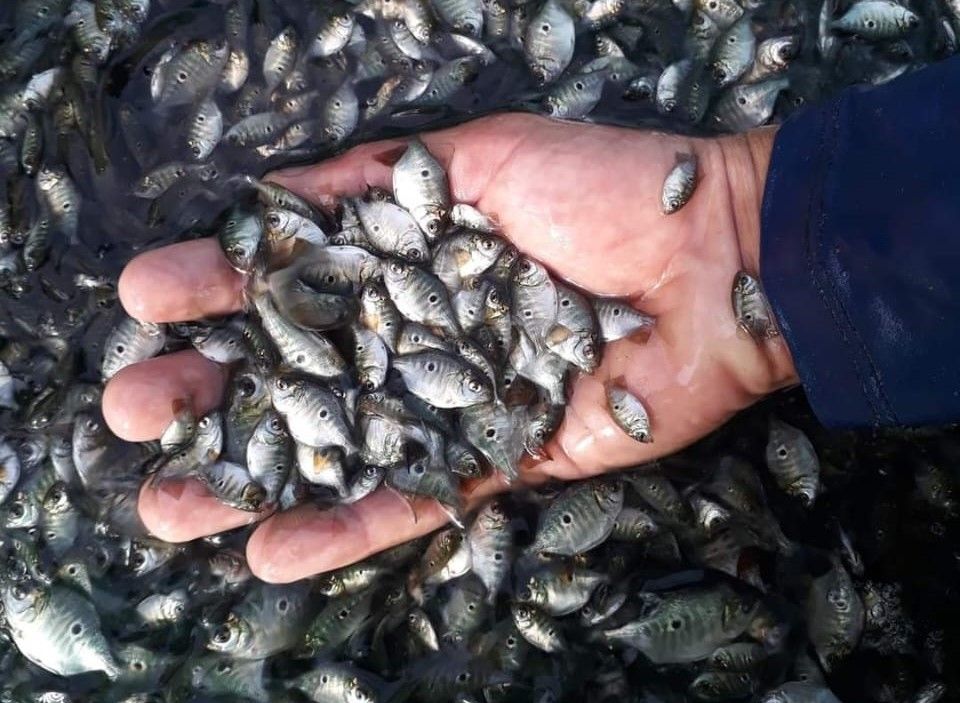
Yuri Moraes has been a rural producer at Piscicultura Tataueira for nearly 15 years in the municipality of Peixe-Boi, in northeastern Pará. He explains that his family invested in tambaqui production due to the property’s extensive water network, the state’s strong aquaculture potential, a shortage of high-quality fingerlings (the stage preceding juvenile fish), and the species’ strong marketing.
Currently, production is around 800,000 fingerlings per season, with the breeding period running from January to June. However, the goal is to expand production beyond this calendar. To achieve this, they invest in assisted reproduction with professional/technical support.
“Crossbreeding follows a very rigorous genomic control protocol through subcutaneous microchips that ensure the genetic crossbreeding purity and variability. In this way, we keep the species’ own characteristics. We also conduct zootechnical selection when choosing future breeders that, in partnership with Embrapa (Brazilian Agricultural Research Corporation), are incorporated into the crossbreeding table”, Moraes explains.
For him, there is a lack of government investments so the state can consolidate itself as the country’s leading tambaqui producer.
“Pará urgently needs investment in the agricultural sector along with a serious reform that ensure stability and security for producers in rural areas; adjustments to environmental regulations to make production viable by reducing bureaucracy and legal hurdles; the strengthening of the productive chains as a whole, implementation of fair taxation; and the development of cost-effective transportation options for inputs and processed products that ensure efficient product flow. Currently, the North of Brazil stands in native production due to the performance of Rondônia, while Pará barely has consolidated indicators”, states Moraes.
Keeping an eye on small producers
The fisheries engineer emphasizes that a large share of tambaqui production in Pará comes from the work of small and medium-sized producers, which represents an important contribution from family farming. However, she points out that investment in high technology does not include this significant group of workers who rely on fishing as their source of income.
“We know that there are major initiatives and producers in the Paragominas region, for example, where there is investment in production technology and technical assistance for proper feed management, and they have therefore been successful in achieving high production levels. We know this reality is far from our potential, though”, states Gomes.
In the specialist’s opinion, it is necessary to remove bureaucratic barriers to accessing credit so that local producers in Pará can boost tambaqui marketing in the Amazon region, while also promoting the land, or rather the river, where the species originated and made history.
“To access credit lines and invest in their own production, producers need to be formally regularized. They also need technical assistance in processing and adding value in fish, so that the species can leave the fish farm with added value. This would allow products to reach supermarket shelves or, for example, be sold as fillet cuts or tambaqui ribs. All of this adds value to the product,” the fisheries engineer states.
INSTITUTIONAL PARTNERSHIP
The production of Liberal Amazon is one of the initiatives of the Technical Cooperation Agreement between the Liberal Group and the Federal University of Pará. The articles involving research from UFPA are revised by professionals from the academy. The translation of the content is also provided by the agreement, through the research project ET-Multi: Translation Studies: multifaces and multisemiotics.